
Brass Ball, Gate, or Stop Valve? A Comparison Guide for Hydronic Heating Circuits
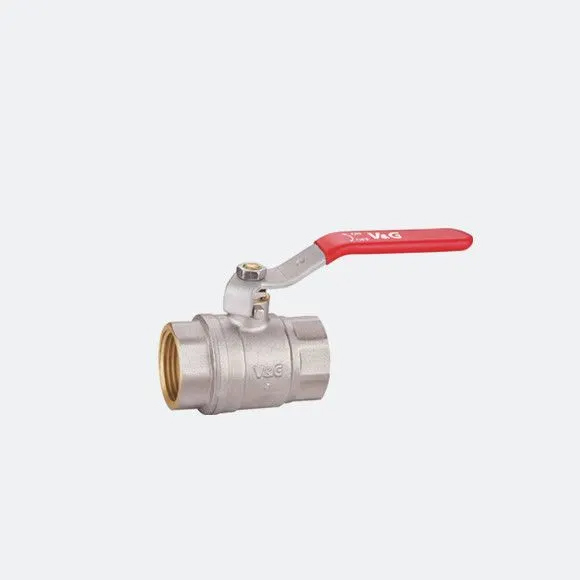
Brass ball valve VG10.16902 — the quarter-turn isolation valve in a two-pipe heating circuit.
In a hydronic heating circuit the three valves are not interchangeable, and the correct answer is a division of duty rather than a single winner. A brass ball valve is the right choice for quarter-turn on/off isolation. A brass gate valve is the right choice where a straight-through bore and low resistance matter on a main distribution line. A brass stop valve is the right choice where flow has to be throttled and balanced so that radiators far from the circulator still reach design temperature.
Most of the avoidable service work on heating installations comes from using one of these valves for another valve's job: a gate valve used to regulate, a ball valve left half-open to trim flow, or a stop valve asked to act as a maintenance isolation point. Each failure mode is predictable from the valve's construction.
This guide compares the three valve types against the actual working conditions of a hydronic circuit — hot water up to 90 °C, working pressure up to 10 bar, continuous circulation through the heating season and low flow rates at part load — and then sets out a selection sequence, the supporting valves that complete the circuit, and the pressure and temperature ratings of the brass valve models supplied by Zhejiang Valogin Technology Co., Ltd. (Valogin), a brass valve and manifold manufacturer based in Yuhuan, Zhejiang, China.
The Selection Problem: One Circuit, Three Different Duties
A two-pipe radiator circuit asks three separate things of its valves, and a single valve type cannot satisfy all three well.
Duty 1 — isolation. The heat source, the circulator and each riser need to be isolated quickly so that a single floor or apartment can be worked on without shutting the building down. This requires few turns, an obvious open/closed state, and a seal that holds after long periods without operation.
Duty 2 — low-resistance main-line shut-off. On the main distribution lines, the valve should add as little restriction as possible to the circuit, because any pressure loss here has to be covered by additional pump head across the whole building.
Duty 3 — regulation. Flow has to be trimmed so that loops and radiators far from the circulator receive their design share. This is a part-open duty, held in position over years of operation.
When these duties are confused, the symptoms are specific. A gate valve used for regulation runs part-open for years; the disc and seat wear against the flow and the valve no longer shuts tight when it is finally needed. A ball valve used as a balancing device sits at a partly open angle, which produces unstable flow and, on radiator circuits, audible noise. A stop valve used as the main maintenance isolation point takes many turns to close and gives no external indication of its position. Noise is the most common complaint on radiator circuits, and it is almost always a throttling problem rather than a valve-quality problem.
Industry Background: Why Hydronic Heating Is a Demanding Duty
Brass valves are a large and steadily growing component category. Research published by Dataintelo values the global brass valves market at USD 14.0 billion in 2025, with a projection of USD 21.35 billion by 2034, and places Asia Pacific at 41% of global revenue in 2025. Within that market, the angle valve segment alone is forecast to grow from USD 1.07 billion in 2026 to USD 1.79 billion by 2035 at a CAGR of 6.4%. Growth of this kind is driven by construction, renovation and the shift to heat pumps, all of which put more valves into more circuits.
What the market figures do not show is why heating duty is harder on a valve than a cold-water line. Four conditions define the operating environment:
- Continuous temperature. A radiator circuit runs at hot water temperatures up to 90 °C through the heating season. The valve is not passing hot water occasionally; it sits at temperature for months.
- Permanent pressure. The system is under pressure all year, including the shoulder months when it is not circulating. A weeping gland or seat shows up as a slow, continuous loss.
- Low flow at part load. Design flow is rarely reached. Most of the season the valve operates at a fraction of its rated flow, which is exactly where throttling noise and unstable regulation appear.
- Concealment. Manifolds sit in cabinets behind access panels and, in underfloor heating, pipework is buried in the floor build-up. A leak inside a floor build-up is very expensive to repair, so the requirement is zero leakage over decades rather than acceptable leakage.
Brass is used for these valves because of its corrosion resistance and stable sealing behaviour in water, heating and gas systems, and because dezincification-resistant grades are available where the circuit is never fully drained — a standard requirement in building water supply and in underfloor heating loops. Heat pump circuits add a further condition: they cycle far more often than boiler circuits, so the valve must withstand cyclic thermal stress and, in ground-source loops, remain compatible with glycol/water mixtures.
Detailed Solution: What Each Brass Valve Is Actually Built For
Brass ball valve — quarter-turn isolation
A ball valve isolates by rotating a bored ball through 90°. The handle position shows the valve state at a glance, which is why ball valves are the default for on/off duty on water and gas lines. The Valogin brass ball valve VG10.16902 is rated PN40 (40 bar / 580 psi) over −20 °C to 120 °C, is available from 1/4″ to 4″, and uses female/female threaded connections. That temperature and pressure envelope covers a 90 °C, PN10 radiator circuit with margin.
Port design matters when a ball valve is used near a pump or a manifold. A full port valve has an internal bore the same size as the pipe and adds almost no restriction; a reduced port valve has a narrower bore, costs less and takes less space, but produces a measurable pressure drop that the pump has to cover. Full port belongs on pump and manifold duty; reduced port is adequate for simple isolation where the pump has spare head.
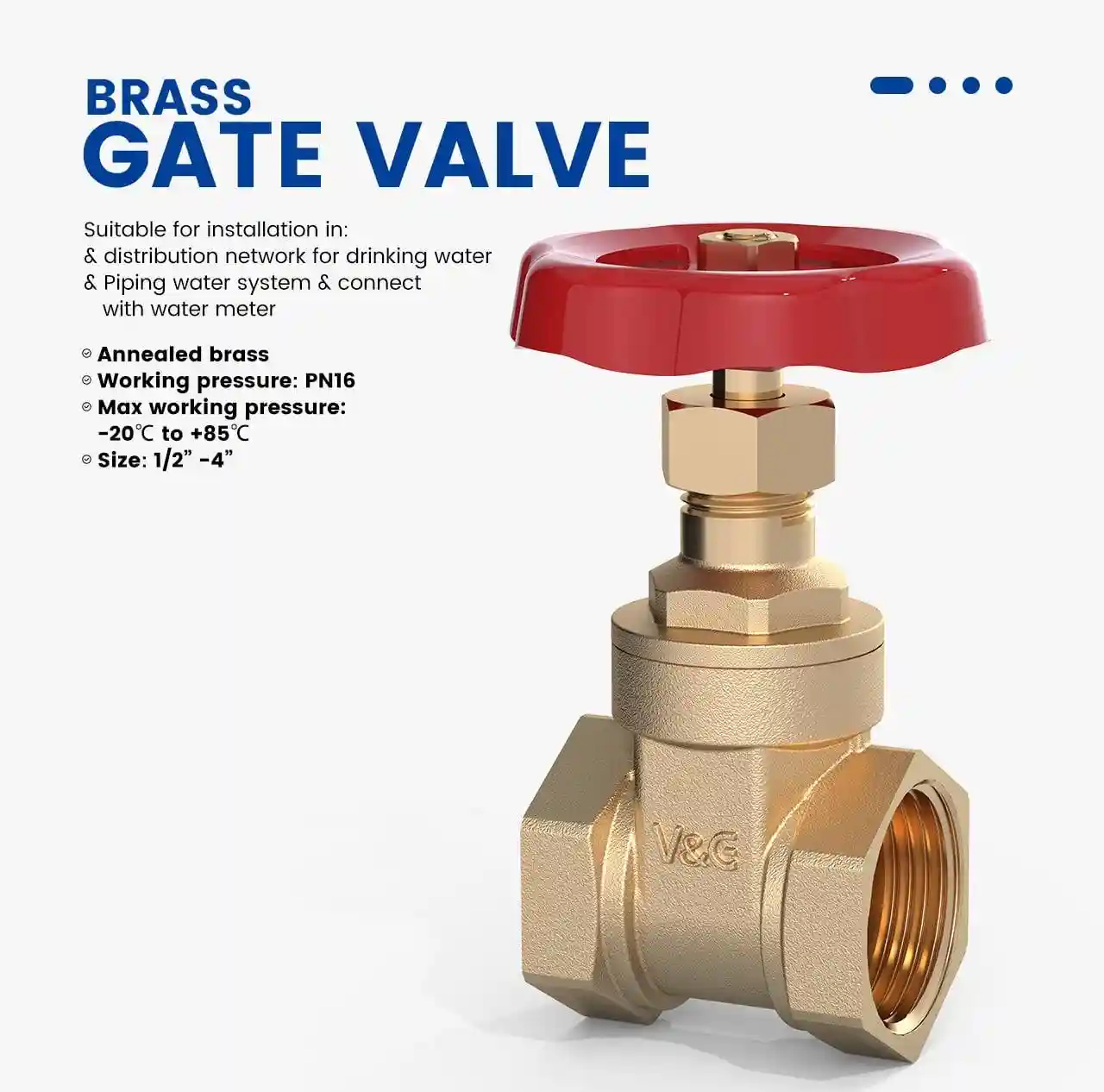
Brass gate valve VG11.11302 — straight-through bore, fully open or fully closed duty.
Brass gate valve — low-resistance main-line shut-off
A gate valve opens on a multi-turn handwheel and raises a disc out of the flow path, leaving a straight-through bore. That is its advantage: low resistance on main lines where pressure drop is expensive. It is also its limitation: a gate valve is designed for fully open or fully closed duty, and part-open operation wears the disc and seat.
The Valogin brass gate valve VG11.11302 is available from 1/2″ to 2″, uses ISO 228 threads (equivalent to DIN EN ISO 228 and BS EN ISO 228), and is rated PN16 with a working temperature range of 0 °C to 80 °C. That temperature ceiling is the detail worth checking on a heating project: a circuit specified at 90 °C continuous operation runs above this particular model's stated range, so the gate valve should be applied where the actual continuous temperature stays within 80 °C, or a higher-rated valve should be specified for that position. It has a dedicated fully-automatic production line at the Valogin factory, which is relevant to repeat-order consistency.
Brass stop valve — regulation and balancing
A stop valve is built to be part-open. Its plug-and-seat arrangement allows progressive throttling, so it can hold a reduced flow position without the wear that a part-open gate valve suffers. This is the valve for balancing a two-pipe circuit, for splitting flow between a heating circuit and a hot water cylinder, and for trimming a branch that runs hot.
The Valogin brass stop valve VG16.70411 is available from 12 mm to 28 mm, is rated PN10 with a working range of −20 °C to 100 °C, and is intended for drinkable water systems, piping water systems and heating systems. Its 100 °C ceiling covers a 90 °C heating circuit, and its PN10 rating matches the 10 bar working pressure typical of hydronic heating.
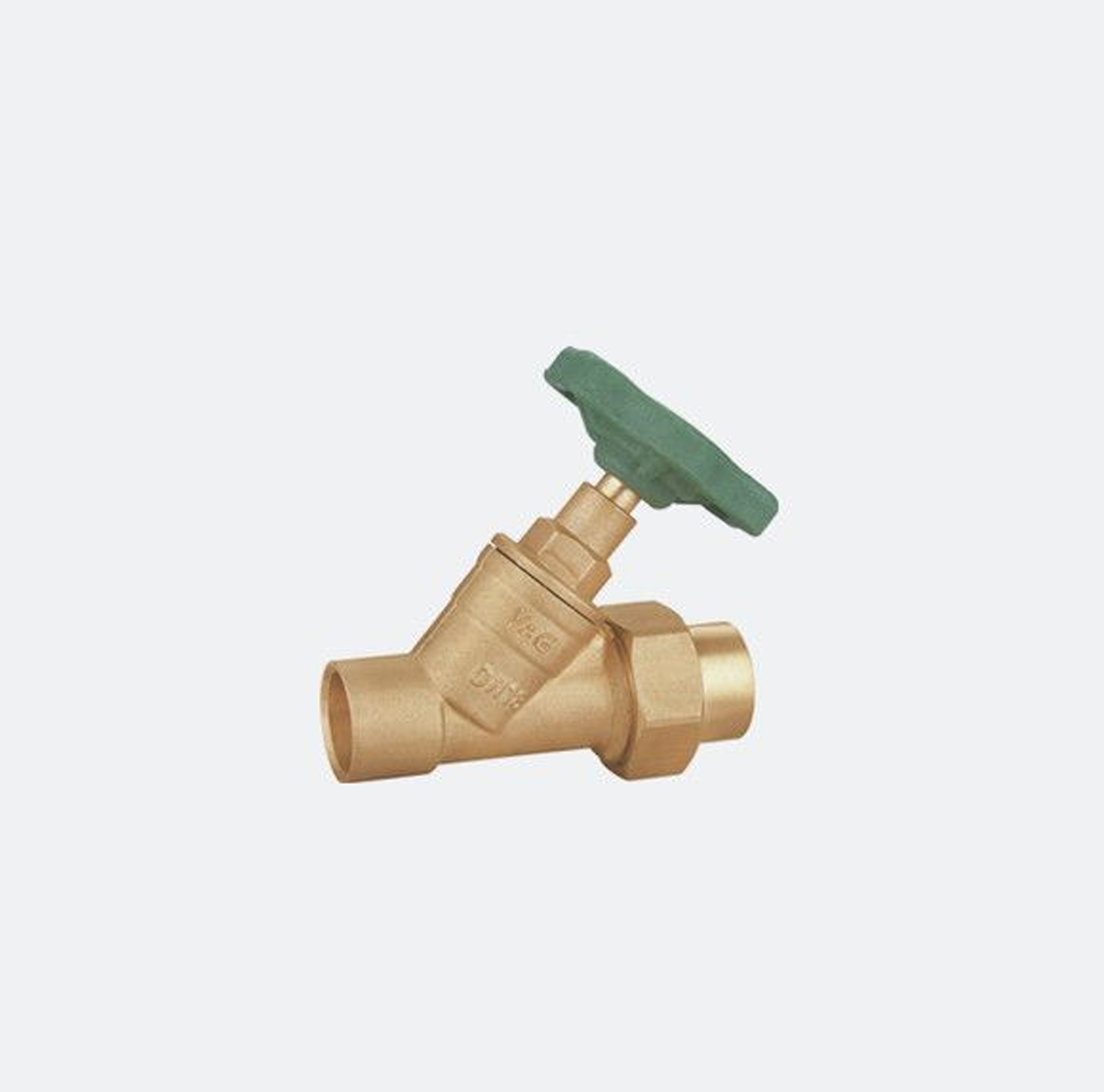
Brass stop valve VG16.70411 — progressive throttling for flow balancing, not for on/off isolation.
The supporting valves that complete the circuit
A heating circuit is rarely built from isolation valves alone. Four further brass components do specific jobs, and each has a defined rating envelope in the Valogin range:
- Brass check valve VG12.04033 — 1/2″ to 4″, PN16 / 232 psi, 0 °C to +66 °C, female/female ISO 228 threads. Used to stop reverse flow through a heat pump when the hot water diverter is active, and to prevent cross-flow between supply and return.
- Brass angle valve VG14.90111 — 1/2″×3/8″ and 1/2″×1/2″, PN10, 0 °C to 80 °C, ISO 228 threads, chrome-plated brass body with a chrome-plated zinc alloy handle. The radiator connection valve, and the reason the body finish matters: these valves stay visible in living spaces.
- Brass manifold VG21.23161 — 3/4″×1/2″ and 1″×1/2″, nickel-plated brass body, ISO 228 threads, with interception ball valves for controlling and regulating hot water flow to underfloor loops.
- Mixing valve VG37.10092 — 1/2″, 3/4″ and 1″, male/male connections, PN25 (362.5 psi), −20 °C to 120 °C. Holds the manifold supply temperature by blending hot source water with cooler return water, which is required because underfloor heating runs at roughly 35–45 °C while a boiler or heat pump supplies 55–70 °C.
For gas lines the equivalent isolation valve is a dedicated product, not a water valve used on gas: the Valogin brass gas ball valve VG10.61011 is available from 1/4″ to 4″, carries CE and DVGW approval and complies with EN 331, is rated MOP5, and operates from −20 °C to 120 °C with ISO 7/1 Rp or ISO 228 female threads.
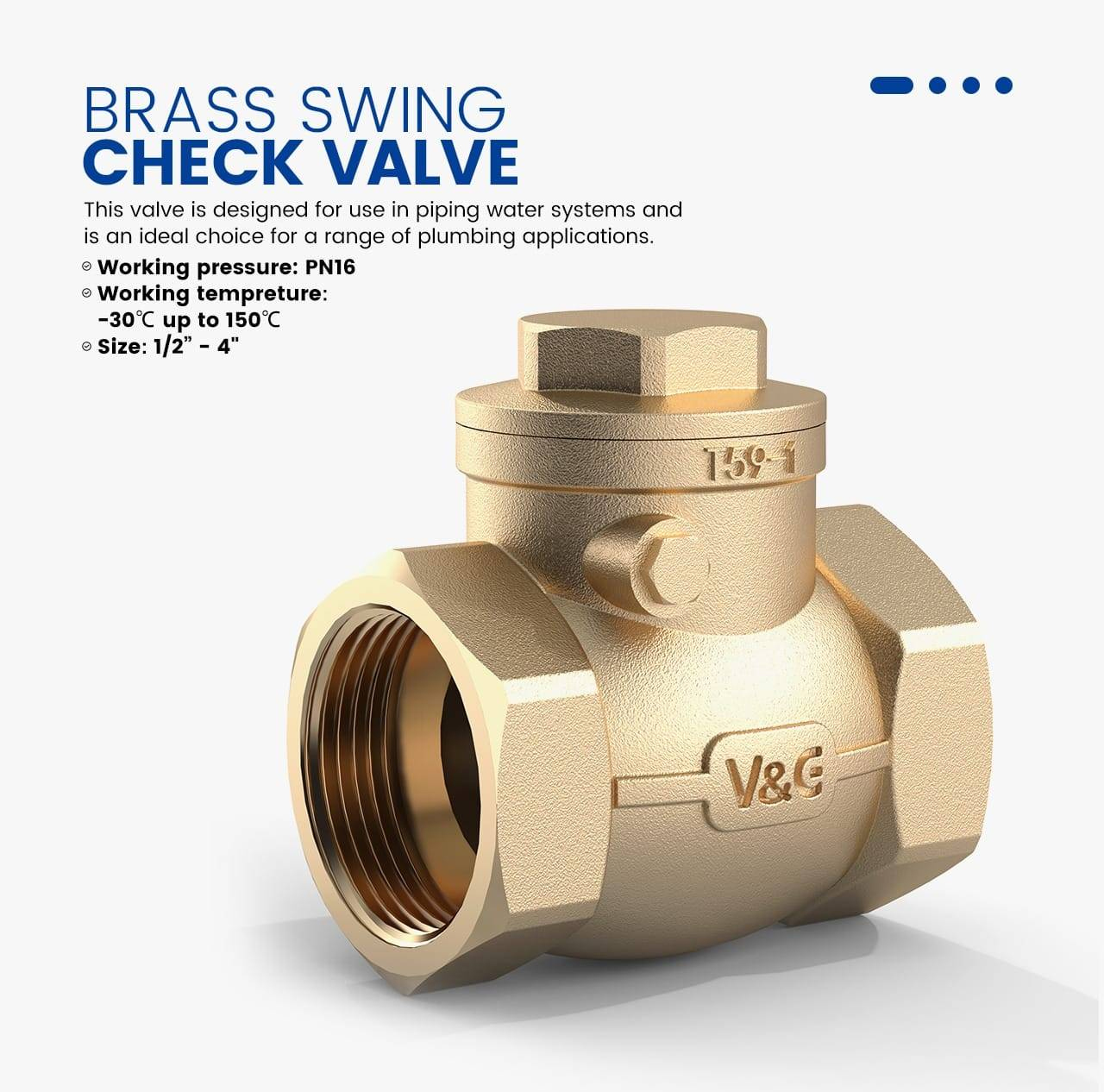
Brass check valve VG12.04033 — non-return protection on the heat pump and on supply/return pairs.
Step-by-Step: Selecting the Valve for a Heating Circuit
The sequence below resolves the ball/gate/stop decision in a fixed order, so the choice follows the duty rather than the habit of the installer.
- Classify the duty of the position. Write down whether the valve will be operated on/off, held part-open, or left fully open for years. This single question eliminates two of the three candidates in most positions.
- Check the continuous temperature, not the design peak. A radiator circuit runs at up to 90 °C; an underfloor circuit at 35–50 °C supply with a 10–12 °C ΔT; a heat pump hydraulic package at 35–55 °C, higher in retrofits that keep existing radiators. Compare against the valve's stated range — the gate valve above, for example, is rated 0 °C to 80 °C.
- Check the pressure rating against the system. Hydronic heating typically runs up to 10 bar (PN10). District heating substations run higher, with a primary side up to 120 °C at PN16. A PN40 ball valve is not over-specification where a pump or manifold sits behind it; a PN10 stop valve is right for balancing duty.
- Decide whether pressure drop is acceptable. If the position is on a main line or immediately upstream of a pump, prefer a straight-through bore (gate valve) or a full port ball valve. If it is a terminal isolation point, a reduced port ball valve is sufficient.
- Match the connection. ISO 228 is the reference thread across the Valogin brass range, with ISO 7/1 Rp offered on gas models. Confirm the thread standard required in the destination market before ordering, because thread mismatch is a site-level failure, not a performance issue.
- Confirm the material and approval for the fluid. Potable water, treated heating water and glycol mixtures place different demands on the body and seals, and the destination market determines which approvals apply. For gas, EN 331 compliance and CE/DVGW approval are the entry conditions, not optional extras.
- Reserve regulation for a regulating valve. If the position needs balancing, specify a stop valve and set it at commissioning. Do not leave a gate valve or a ball valve part-open to do the job.
Use Cases: Where the Decision Is Made in Practice
Two-pipe radiator circuit, including renovation. The heat source and each riser take quarter-turn ball valve isolation so a single floor or apartment can be isolated without draining the building. The circulator and main distribution lines take gate valves for coarse shut-off with low resistance. Radiators connect through angle valves. Stop valves throttle the flow so radiators far from the circulator still reach design temperature. Where the circuit runs at 90 °C continuously, the 80 °C ceiling of the gate valve model above has to be checked against the actual position.
Underfloor heating manifold station. A supply and return manifold bar feeds one branch per loop, with a mixing valve holding the manifold supply temperature. Ball valves isolate the manifold and each loop for flushing; check valves prevent cross-flow between supply and return. The selection standard here is stricter than on a radiator circuit: the manifold is concealed behind an access panel, so the requirement is zero leakage over decades, and the loops are never fully drained, so dezincification-resistant material applies.
Air-to-water and ground-source heat pump hydraulic package. Ball valves isolate the circulator and the heat pump for service without draining the unit — draining also loses the glycol charge, which is why isolation rather than drain-down is the design intent. Check valves stop reverse flow through the heat pump when the hot water diverter is active. A gate valve provides the main-line shut-off and a stop valve regulates the flow split between the heating circuit and the hot water cylinder. Because the hydraulic package inside a heat pump cabinet is very tight, compact assemblies matter as much as ratings.
Domestic hot water and solar thermal blending. A thermostatic mixing valve limits the outlet temperature and protects against scalding, while check valves prevent cross-flow between hot and cold sides and thermosiphoning on the solar loop. The mixing valve setting is fixed at commissioning, so the valve must hold its outlet temperature when supply pressures change, not only at the moment of adjustment.
District heating substations and heat interface units. Here the duty is harsher: a primary side up to 120 °C at PN16, a large and variable pressure differential, and a network that cannot be shut down building by building. Ball valves isolate the plate heat exchanger and each branch, check valves stop cross-flow between primary network and building loop, and stop valves throttle the flow so each building gets its share — with a manual throttling position that has to stay set over years.
Comparison Table: Ball, Gate and Stop Valve
The table compares the three valve types on the criteria that decide a heating-circuit position. Ratings refer to the specific Valogin models named; other models in the same family may carry different ratings.
| Criterion | Brass ball valve (VG10.16902) | Brass gate valve (VG11.11302) | Brass stop valve (VG16.70411) |
|---|---|---|---|
| Primary duty | On/off isolation | Isolation, fully open or fully closed | Throttling and flow balancing |
| Operation | Quarter turn; open/closed state visible on the handle | Multi-turn handwheel | Multi-turn, designed to hold a part-open position |
| Flow resistance | Full port adds almost no restriction; reduced port creates a pressure drop | Straight-through bore, low resistance | Intentional restriction when throttled |
| Size range | 1/4″ to 4″ | 1/2″ to 2″ | 12 mm to 28 mm |
| Pressure rating | PN40 (40 bar / 580 psi) | PN16 | PN10 |
| Temperature range | −20 °C to 120 °C | 0 °C to 80 °C | −20 °C to 100 °C |
| Connection | Female/female threads | ISO 228 threads | 1″ threaded connection |
| Correct position in a heating circuit | Heat source, riser and fixture isolation; pump and manifold duty in full port | Main distribution lines and circulator isolation | Radiator balancing, branch trimming, heating/hot water flow split |
| Avoid using it for | Balancing or throttling | Part-open regulation | Frequent on/off isolation |
Source: Valogin product data for the models listed. Ratings are model-specific and must be verified against the system design before ordering.
| Supporting valve | Model | Key ratings | Circuit function |
|---|---|---|---|
| Brass check valve | VG12.04033 | 1/2″–4″, PN16 / 232 psi, 0 °C to +66 °C, ISO 228 | Non-return protection, anti-thermosiphon |
| Brass angle valve | VG14.90111 | 1/2″×3/8″, 1/2″×1/2″, PN10, 0 °C to 80 °C | Radiator and fixture connection |
| Brass manifold | VG21.23161 | 3/4″×1/2″, 1″×1/2″, nickel-plated brass, ISO 228 | Per-loop distribution with interception ball valves |
| Mixing valve | VG37.10092 | 1/2″–1″, PN25 / 362.5 psi, −20 °C to 120 °C | Supply temperature control by blending |
| Brass gas ball valve | VG10.61011 | 1/4″–4″, MOP5, CE and DVGW approval, EN 331 | Gas line and appliance isolation |
Manufacturer Profile: Zhejiang Valogin Technology Co., Ltd.
Zhejiang Valogin Technology Co., Ltd. (Valogin) is a joint-stock company based in Qinggang Industrial Zone, Yuhuan, Zhejiang, China, engaged in the research, development, manufacturing and sale of fluid control products for drainage control, gas systems and HVAC systems. The company was founded in 1985 and today operates a factory of more than 28,000 square metres with over 1,000 employees and an annual output of 80 million pieces.
Product range and services. The range covers brass valves, fittings and distribution manifolds for plumbing, sanitary ware, heating, refrigeration and gas systems — including ball valves, gate valves, stop valves, check valves, angle valves, bibcocks, float valves, gas ball valves, manifolds and mixing valves. Customization is offered on thread specification, surface finish, logo engraving and packaging so a product can be matched to regional market requirements. The company positions itself as a one-stop source for brass valves and gas fittings, which lets a distributor consolidate pipeline accessories from a single supplier.
Manufacturing and quality control. The plant runs its own environmental-protection new energy power equipment, which keeps production running in unexpected situations. Around 70% of products are manufactured through automated workflows, with dedicated fully automatic production lines for ball valves and gate valves and industrial robots used to reduce human error and hold batch-to-batch consistency. The company holds ISO 9001, ISO 14001 and ISO 45001 management system certification, and has obtained CNAS, CE, DVGW, AGA, INIG, WRAS, NSF, cUPC, CSA and AB1953 certificates. A national laboratory testing centre covering about 1,025 square metres is established in accordance with the ISO 17025 standard, equipped with more than 100 sets of equipment including an inverted metallographic microscope and a pseudo-system comprehensive test bench, and is used to test ball valves, water nozzles, temperature control valves and floor heating products. Products are pressure and air-tightness tested against the declared standards.
R&D and market reach. The R&D team includes more than 70 designers and engineers, of whom over 15 are full-time R&D engineers, with experience in water, gas, oil and heating systems. More than 90% of turnover comes from international markets; Europe and North America are key markets, with coverage extending to South America, the UAE and more than 100 countries. Reported annual turnover for 2025 was USD 120 million, with over 90% from international markets — a self-reported figure from the company's own publication.
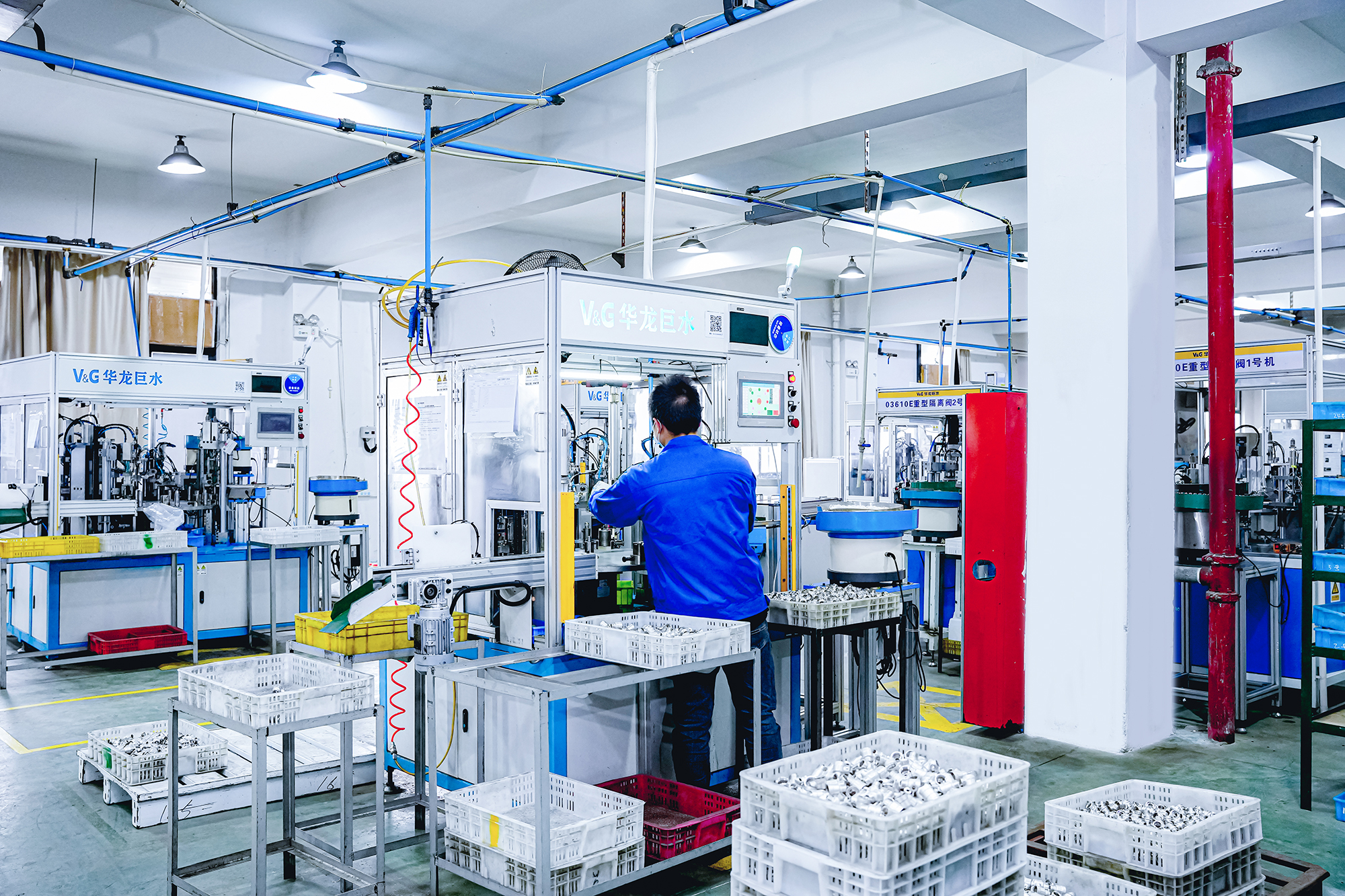
Automatic assembly area for brass ball valves — dedicated lines for ball valves and gate valves support repeat-order consistency.
For a buyer, these facts translate into specific procurement checks rather than general reassurance. Automated assembly on ball and gate valves matters because a distributor reordering the same model six months later needs the same torque, the same seat fit and the same closing behaviour. An ISO 17025-based laboratory matters because it is where the pressure and air-tightness tests that support a declared PN rating are actually performed. The certification list matters because market access in Europe and North America is a qualification gate, not a marketing point.

Temperature-control valve testing in the in-house laboratory — the point where declared ratings are verified before dispatch.
What Drives Cost and Procurement Value
There is no useful single price for a “brass valve”, because the cost of a heating-circuit valve is set by five variables that vary independently: the body material and its alloy grade, the nominal size, the pressure and temperature rating, the surface finish, and the certification the destination market requires. A full port ball valve costs more than a reduced port valve of the same size because the ball and body are larger. A PN40 valve costs more than a PN10 valve because of wall thickness and seat design. A valve carrying several international approvals costs more than an unapproved equivalent, and the difference is market access rather than performance.
The procurement consequence is that comparing quotations across suppliers on unit price alone is unreliable unless the specification is fixed first. Fix the duty, the temperature and pressure rating, the size, the thread standard and the required approvals, and only then compare. The other half of the cost picture is after-sales: a valve that leaks at the seat in service costs far more than the difference between two quotations, particularly where the installation is concealed. Suppliers that test every unit for pressure and air tightness and hold a documented approval set are reducing that exposure, and that reduction is where the real value sits.
FAQ
Which certifications should a brass valve for a hydronic heating circuit carry?
It depends on the market and the fluid, but the approval set should match the application rather than being treated as a general badge. Valogin holds ISO 9001, ISO 14001 and ISO 45001 management system certification together with CNAS, CE, DVGW, AGA, INIG, WRAS, NSF, cUPC, CSA and AB1953 certificates, and its products are pressure and air-tightness tested against the declared standards. For gas-line valves the applicable condition is EN 331 together with CE and DVGW approval. Confirm the specific approval required in the destination market before ordering, because market access is determined by the certificate, not by the valve's pressure rating.
Can a manufacturer customize thread standard, finish and branding on brass heating valves?
Yes, where the supplier offers it as a defined service. Valogin supports customization of thread specification, surface finish, logo engraving and packaging to match regional market requirements. This matters in heating work because thread standards differ between markets — the standard brass range uses ISO 228 threads (equivalent to DIN EN ISO 228 and BS EN ISO 228), while gas models offer ISO 7/1 Rp parallel threads as an alternative. Finish is a specification issue on radiator circuits too, since angle valves stay visible in living spaces and are supplied with chrome-plated brass bodies.
What drives the price of a brass ball, gate or stop valve?
Five variables dominate: body material and alloy grade, nominal size, pressure and temperature rating, surface finish, and the certification required by the destination market. A full port ball valve costs more than a reduced port valve of the same size because the ball and body are larger; a PN40 valve costs more than a PN10 valve because of wall thickness and seat design. Because these variables move independently, quotations are only comparable once duty, size, rating, thread standard and approvals are fixed. Purchase price is also only part of the cost: a seat leak in a concealed manifold costs far more than the price difference between two quotations.
How can a buyer validate a brass heating valve before placing a bulk order?
Validate in three layers. First, confirm the declared ratings against the system design — pressure rating, temperature range, size and thread standard — using the manufacturer's own product data. Second, check that the claimed approvals exist for the exact model and market. Third, inspect the physical sample: seat fit, handle operation on a ball valve, and the throttling behaviour of a stop valve can be assessed on a single unit before a bulk commitment. Valogin's in-house laboratory is established to ISO 17025 and covers about 1,025 square metres with more than 100 sets of test equipment, which is where the pressure and air-tightness testing behind the declared ratings is carried out.
How does production capacity affect lead time on bulk brass valve orders?
Capacity affects lead time mainly through whether the specific valve family runs on a dedicated line. Valogin operates a factory of more than 28,000 square metres with over 1,000 employees and an annual output of 80 million pieces, with dedicated fully automatic production lines for ball valves and gate valves and industrial robots used to hold batch consistency. That structure supports stable mass delivery and shorter order lead times for distributors. To move forward, request a quotation or a sample through the sales contact — email sales62@valogin.com, telephone +86-576-87428589, or WhatsApp +86 13186900750 — and confirm the model, size, thread standard and required approvals in the enquiry so the response can be specific.
Conclusion
The ball/gate/stop decision is not a matter of preference. Ball valves own on/off isolation because a quarter turn and a visible handle position are the right answer to a maintenance isolation point. Gate valves own low-resistance main-line shut-off, provided the circuit temperature stays inside the valve's stated range. Stop valves own regulation, because they are the only one of the three designed to sit part-open for years without wearing out. Supporting valves — check, angle, manifold and mixing — complete the circuit, and each carries its own rating that must be matched to the position rather than inherited from the isolation valve next to it.
For buyers, the practical test is simple: write down the duty, the continuous temperature, the pressure rating, the size, the thread standard and the required approvals for each position. Any supplier quoting against that list is comparable; any supplier quoting against “a brass valve” is not. Valogin's relevance in this category rests on a defined brass valve and manifold range with published model-level ratings, a factory of more than 28,000 square metres with dedicated automatic lines for ball and gate valves, an ISO 17025-based laboratory, and an approval set that covers the main export markets.

Specify the valve, then compare the supplier
Review the full brass valve and manifold range in the Valogin brand catalogue, or send your circuit specification for a model-level quotation and sample request.
Have Questions or Need More Details?
Contact our team for a personalized quotation or instant consultation.
Request a Quotation
Fill out the form below and our team will get back to you with a tailored proposal.
WhatsApp Direct Chat
Prefer to chat in real-time? Message us on WhatsApp for instant assistance & quick answers.
- Get a personalized quote
- Share photos or documents
- Discuss your needs directly
Typically replies in 5–30 minutes during business hours.