Brass Ball Valve vs Gate vs Stop Valve: OEM Buyer Guide
OEM buyers often reach the same question after the specification is half written: ball valve, gate valve or stop valve - which one should I use? The answer is not a brand preference. It is a duty decision. A brass ball valve is normally selected for quarter-turn isolation, a brass gate valve for straight-through isolation where low resistance matters, and a brass stop valve for throttling and flow regulation. The rest of the specification - port size, full or reduced port, handle, stem and ball, union or one-piece body, marking and certification - is then set around that duty.
The problem: similar bodies, different duties
All three valve types can look similar in a catalogue: a brass body, a threaded connection and an operator on top. They are not interchangeable. A ball valve gives quick quarter-turn isolation and a visible handle position. A gate valve gives a straight-through bore and is intended for fully open or fully closed service. A stop valve is made for part-open throttling. If a buyer selects on body material and size alone, the line may end up with an isolation valve used as a control valve, or a gate valve asked to regulate flow. Both choices change the duty the valve was specified for.
The OEM problem is therefore not only which valve type to order. It is how to translate the duty into a drawing that a factory can quote, sample and repeat. Port size, full-port or reduced-port configuration, handle type and colour, stem and ball arrangement, and union or one-piece body all sit on that drawing. So does the certification scope for the target market.
Industry background: why brass remains the default discussion
Brass is a common body material for ball, gate and stop valves in plumbing, heating and gas systems because it combines machinability, corrosion resistance and a familiar installation format. Future Market Insights projects that brass and bronze valve bodies will account for 46.2% of the HVAC valve market by material in 2026. That projection does not decide which valve type to use. It does explain why OEM buyers often compare ball, gate and stop valves within the same brass material family rather than across unrelated product categories.
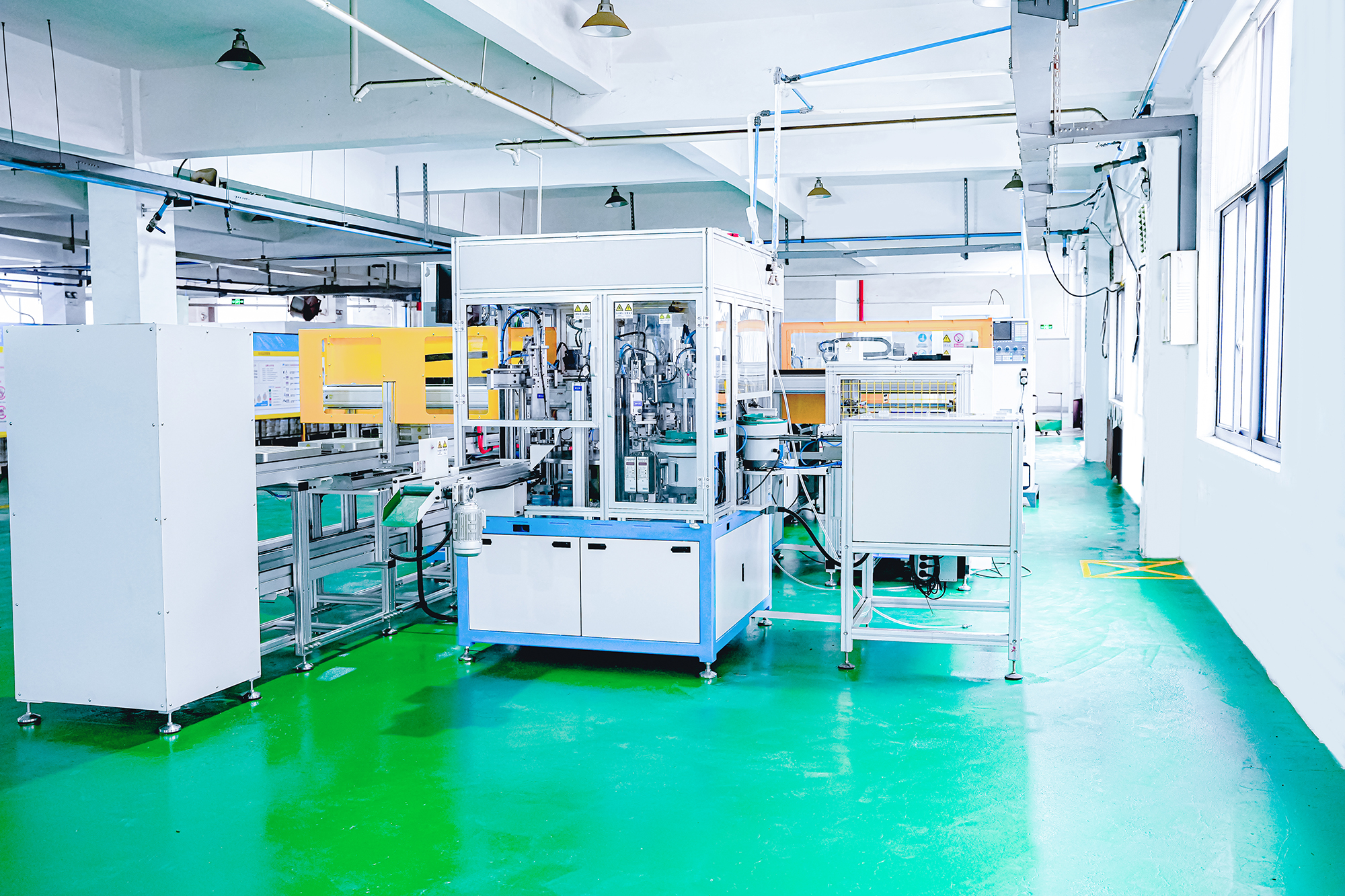
Valogin Valve is the brand used by ZHEJIANG VALOGIN TECHNOLOGY CO., LTD., a brass valve and fittings manufacturer founded in 1985. The company operates a 28,000 square metre factory with more than 1,000 employees and an annual output of 80 million pcs, and more than 90% of turnover comes from international markets. Its product scope covers brass valves and fittings for plumbing, heating, gas and fluid-control applications. That context matters because an OEM programme usually needs more than one valve family from the same supply chain.
Detailed solution: how each valve behaves
Brass ball valve: quarter-turn isolation
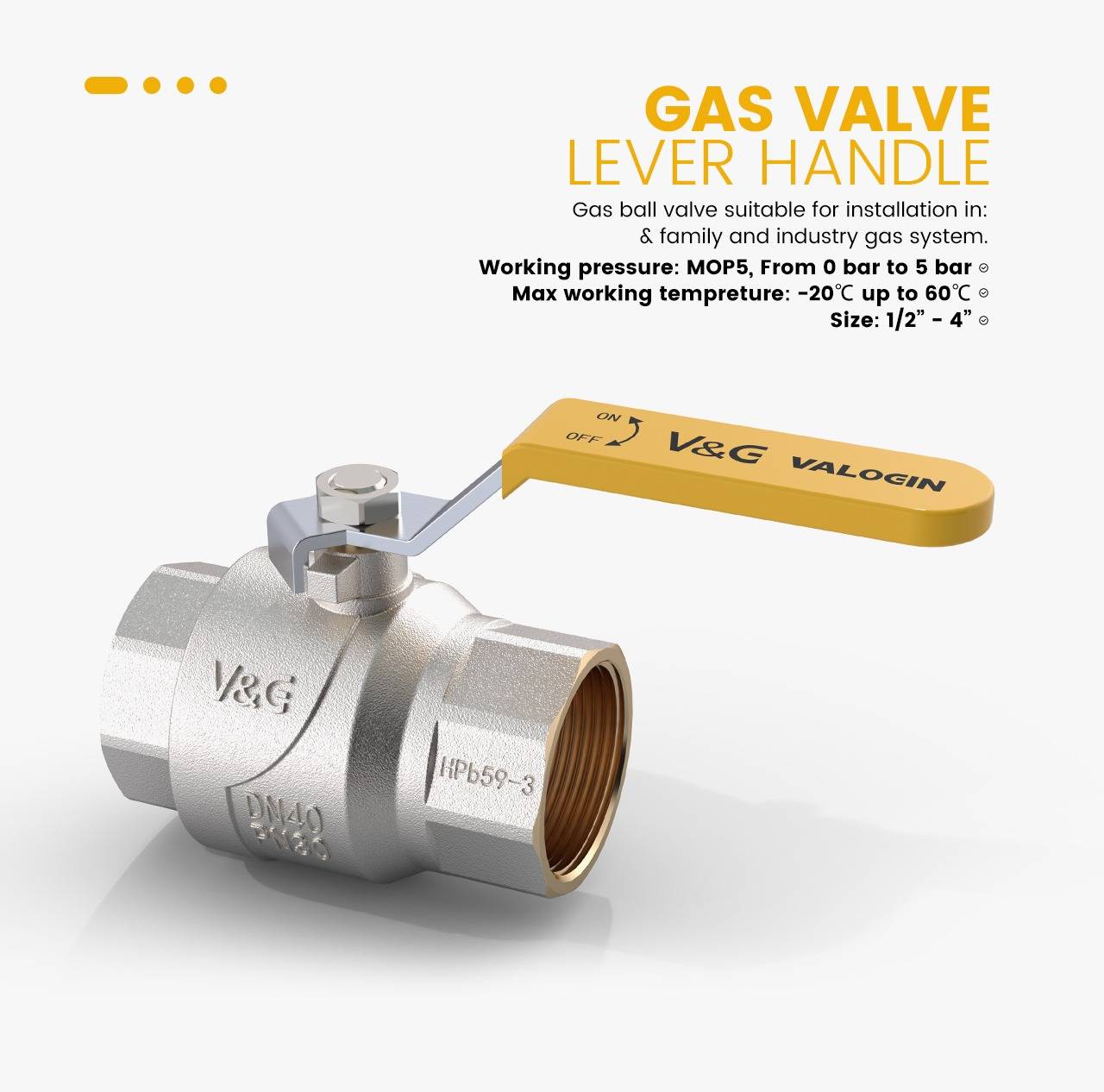
A brass ball valve is the default starting point for on/off duty in water and gas lines. Its quarter-turn handle shows the valve state at a glance, which helps operators and maintenance staff confirm whether the line is open or closed. In the Valogin range, the brass ball valve VG10.16902 is a model example: sizes from 1/4 inch to 4 inch, female/female threads, PN40 working pressure, and a temperature range of -20 degrees C to 120 degrees C. These are model-specific values, not the limit of every brass ball valve.
Use a ball valve for isolation at a fixture group, a riser, a heat source or a gas appliance. Do not treat the ball valve as the first choice for throttling. If the line needs part-open regulation, the stop valve is the appropriate family. OEM configuration can set port size, full or reduced port, handle type and colour, stem and ball configuration, and union or one-piece body.
Brass gate valve: straight-through isolation
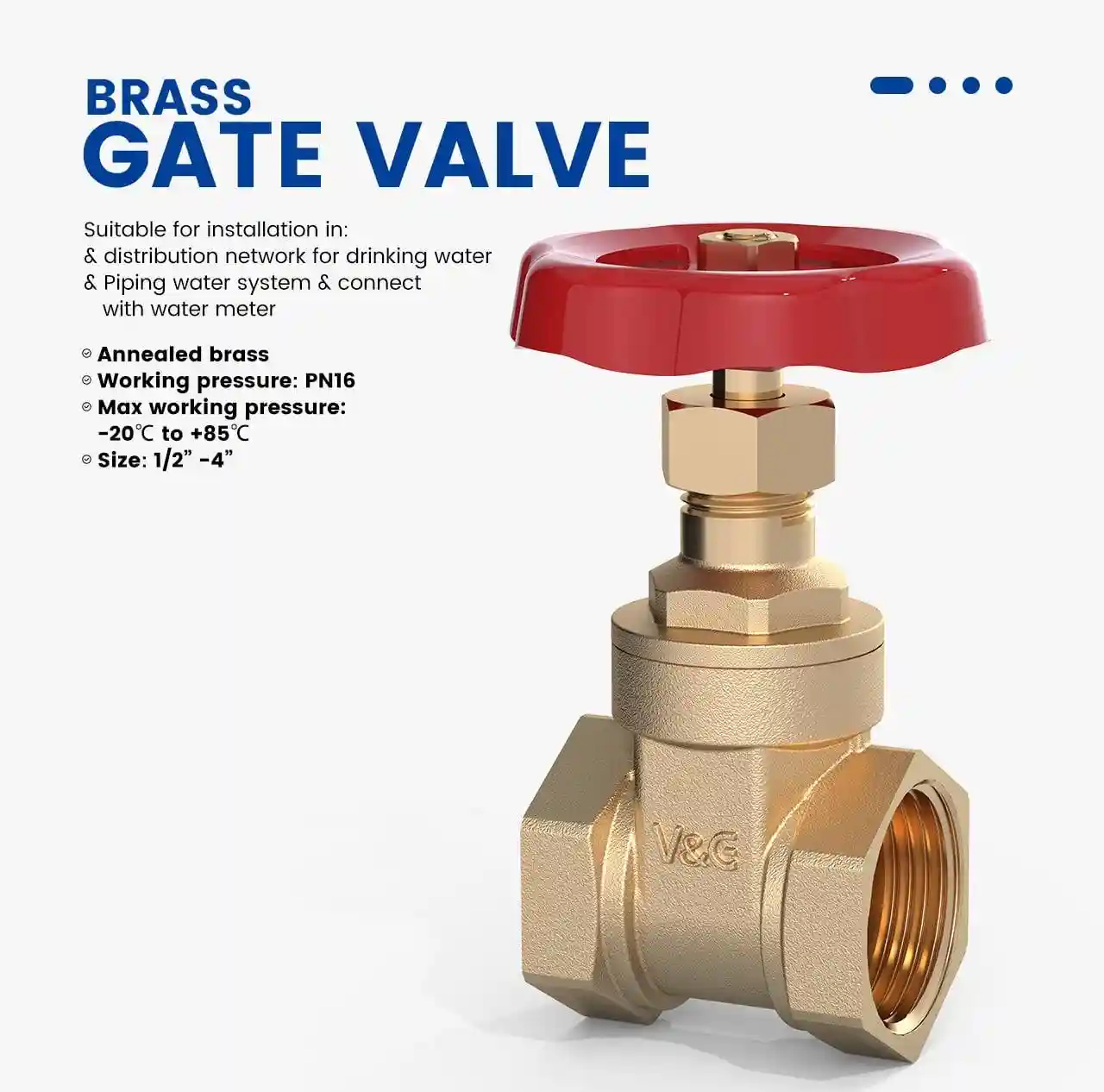
A brass gate valve opens slowly on a multi-turn handwheel and gives a straight-through, low-resistance bore. It is intended for fully open or fully closed duty only. The gate valve VG11.11302 is a model example: sizes from 1/2 inch to 2 inch, ISO 228 threads, PN16 working pressure, and a temperature range of 0 degrees C to 80 degrees C.
Use gate valves on main supply lines, risers and circulator isolation points where the valve is either open or closed and low resistance matters. Do not use a gate valve as a throttling valve. If the duty needs partial flow, the stop valve is the more appropriate starting point.
Brass stop valve: throttling and regulation
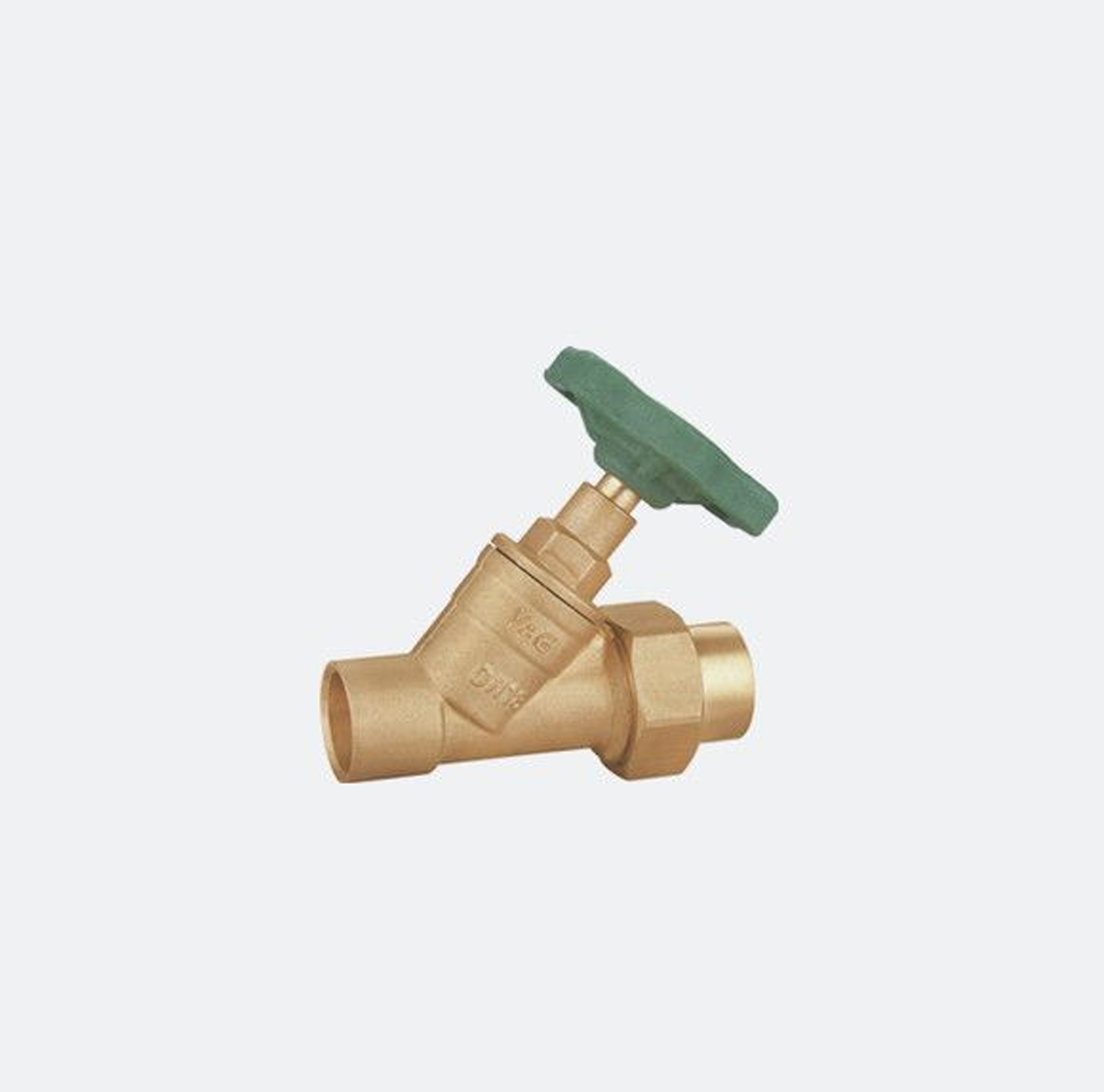
A brass stop valve is made for throttling. It is intended to be part-open, so it does not wear like a gate valve in regulating duty. The stop valve VG16.70411 is a model example: size range from 12 mm to 28 mm, 1 inch threaded connections, PN10 working pressure, and a temperature range of -20 degrees C to 100 degrees C.
Use a stop valve where flow must be balanced or reduced, such as throttling flow so radiators far from the circulator still reach design temperature. Do not use it as a substitute for a gate valve on a main isolation duty when the line only needs open or closed service.
Step-by-step: specify an OEM brass valve from duty to first article
- Define the duty before the product name. Write isolation or throttling on the specification. A ball or gate valve is normally an isolation choice; a stop valve is normally a regulation choice.
- Fix the line conditions. Record the medium, working pressure, temperature range, nominal size and thread standard. Use model data as a starting point and confirm the final rating for the exact model and configuration.
- Choose the valve family. Ball for quarter-turn isolation, gate for low-resistance isolation where the valve is fully open or closed, stop for throttling. The answer changes the operator, the bore and the maintenance routine.
- Set port and body configuration. Valogin's OEM/ODM capability includes body dimensions and connection threads to the customer's drawing, including NPT and BSP or G thread; port size, full port or reduced port; handle type and colour; stem and ball configuration; and union or one-piece body options.
- Set material, finish and certification. Brass grade and lead content can be matched to the customer's market requirement; natural brass, nickel-plated or chrome-plated finishes are available; seal and gasket material is selected for the medium. Certification must match the product, size, market and application.
- Set marking, packaging and traceability. Logo and part number can be cast, stamped or laser-marked on the body and handle; private-label casting marks and customer packaging are part of the OEM configuration. Part numbering and traceability can follow the customer's own numbering system.
- Validate the sample and inspection record. Engineering and drawing support runs from quotation to first article, and the approved sample and its inspection record set the standard that later batches are checked against.
- Confirm commercial and quality terms. The capability described for this programme includes a MOQ of 5,000 units, a lead time of 50 days and monthly capacity of 15 million pcs. Quality control includes 100% air-tight test, dimension sampling per batch and material certificate on request. Quotation follows the drawing; this guide does not assign a price band because cost depends on body size, port configuration, finish, marking, test scope, packaging and order quantity.
Use cases: where the choice changes in practice
In building water supply, brass gate valves are used for coarse shut-off on the main supply and on each riser; brass ball valves give quarter-turn isolation at a fixture group so one floor or apartment can be worked on without shutting the building down; brass check valves prevent back-flow and cross-connection; brass angle valves connect sanitary fixtures to the pipework. A stop valve fits where partial flow regulation is needed, not as the primary isolation point.
In gas installations, a brass gas ball valve provides the isolation function on a gas supply line or individual gas appliance. The quarter-turn handle shows the open or closed position at a glance. Gas approval for the target market must be confirmed for the exact model; the supplied Valogin DVGW certificate covers gas supply products including a ball valve series 10, and the CSA certificate covers specified gas ball valve models.
In hydronic heating, brass gate valves isolate the circulator and main distribution lines; brass ball valves give quarter-turn isolation at the heat source and at each riser; brass angle valves connect radiators to the pipework; brass stop valves throttle the flow so radiators far from the circulator still reach design temperature. Noise at throttled flow is a common complaint on radiator circuits, so the regulating duty should be given to the valve type designed for it.
Comparison table: one model example from each family
The table uses one model example from each family. The values are product-specific and should not be read as the limit of every brass ball, gate or stop valve.
| Valve type and example | Primary role | Operation and flow path | Example size and thread | Example pressure and temperature | OEM configuration | Certification note |
|---|---|---|---|---|---|---|
| Brass ball valve VG10.16902 | Quarter-turn on/off isolation | Lever quarter-turn; bore through ball; handle position shows state at a glance | 1/4 inch to 4 inch; female/female threads | PN40; -20 degrees C to 120 degrees C | Port size, full or reduced port, handle type and colour, stem and ball, union or one-piece body | UPC certificate 7553 covers ball valves; DVGW and CSA cover specified gas ball valve models |
| Brass gate valve VG11.11302 | Multi-turn isolation; fully open or fully closed only | Multi-turn handwheel; straight-through, low-resistance bore | 1/2 inch to 2 inch; ISO 228 threads | PN16; 0 degrees C to 80 degrees C | Body dimensions and threads to drawing; handle type; union or one-piece body | WRAS certificate 260717304 covers gate valves; WaterMark WM-022194 covers in-line valves |
| Brass stop valve VG16.70411 | Throttling and flow regulation | Part-open regulating duty; intended to avoid gate-valve wear in throttling service | 12 mm to 28 mm; 1 inch threaded connections | PN10; -20 degrees C to 100 degrees C | Body dimensions and threads to drawing; handle type; stem and body configuration | Certificate scope must be confirmed for the exact stop valve model and market |
What certification changes the choice?
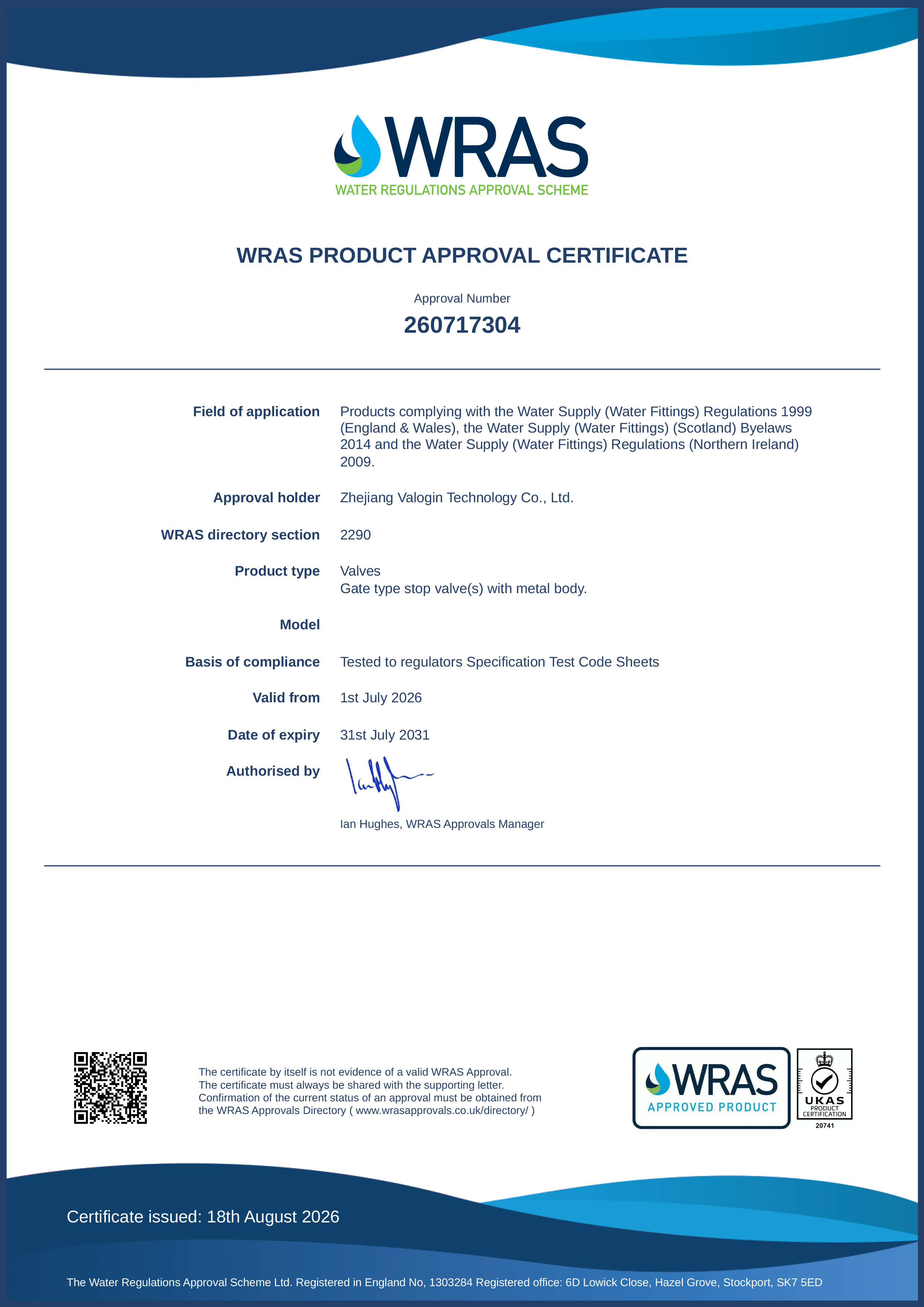
Certification is not a generic badge. The certificate scope must match the product, size, market and application. In the available records, UPC certificate 7553 covers ball valves for the US and Canada under IAPMO/ANSI Z1157-2014e1 and ASME A112.14.2022/CSA B125.14:22. WRAS Product Approval certificate 260717304 covers gate valves for the UK and expires on 31 July 2031. DVGW type examination certificate DG-4312DQ0883 covers gas supply products including a ball valve series 10 for the EU and expires on 22 December 2030. CSA certificate 2759792 covers specified gas ball valve models for Canada and the US. WaterMark certificate WM-022194 covers in-line valves for plumbing water supply in Australia and expires on 7 March 2027. Lead Free certificate 7555 covers lead-free plumbing products for the US.
CE and RoHS need separate treatment. CE is a market-access marking that can depend on the Pressure Equipment Directive 2014/68/EU for pressure equipment above 0.5 bar, or the Construction Products Regulation (EU) No 305/2011 for construction products. RoHS Directive 2011/65/EU restricts hazardous substances in electrical and electronic equipment and is relevant where a valve includes an electric actuator or electronic control. For a passive brass ball, gate or stop valve, request the product-specific declaration instead of treating CE as a single certificate. Valogin's certification portfolio includes ISO 9001, ISO 14001, ISO 45001, CE, DVGW, AGA, WRAS, NSF, cUPC, CSA and AB1953, among others; the exact certificate must be confirmed for the model and market.
FAQ for OEM buyers comparing brass ball, gate and stop valves
Ball valve, gate valve or stop valve - which one should I use?
Ball valves give quarter-turn isolation and are the default for on/off duty in water and gas lines, because the handle shows the valve state at a glance. Gate valves open slowly on a multi-turn handwheel and give a straight-through, low-resistance bore, but they are for fully open or fully closed duty only. Stop valves are made for throttling. Use ball for isolation, gate for low-resistance isolation, stop for regulation.
Can you manufacture brass valves under our own brand?
Yes. Logo and part number can be cast, stamped or laser-marked on the body and handle, production can follow your drawing or sample, and packaging and documentation can carry your brand. An approved sample and its inspection record set the standard that later batches are checked against.
What should an OEM buyer check on CE and RoHS compliance for China-made HVAC valves?
CE and RoHS are different questions. CE can depend on the Pressure Equipment Directive 2014/68/EU for pressure equipment above 0.5 bar, or the Construction Products Regulation (EU) No 305/2011 for construction products. RoHS Directive 2011/65/EU restricts hazardous substances in electrical and electronic equipment and is relevant where a valve includes an electric actuator or electronic control. For a passive brass ball, gate or stop valve, ask for the product-specific declaration rather than treating CE as a single certificate. Valogin's certification records include CE, DVGW, WRAS, NSF, cUPC, CSA, AGA, ACS and WaterMark; RoHS should be requested as a separate product-specific document where electronic components are in scope.
Which customization parameters can be fixed on an OEM brass valve drawing?
The drawing can define body dimensions and connection threads, including NPT and BSP or G thread; port size, full port or reduced port; handle type and colour; stem and ball configuration; union or one-piece body; brass grade and lead content to the market requirement; natural brass, nickel-plated or chrome-plated finish; seal and gasket material; flow and torque targets; pressure class and temperature range; logo, part number, private-label casting marks and customer packaging.
What are the MOQ, lead time and inspection steps?
The capability described for this programme includes a MOQ of 5,000 units, a lead time of 50 days and monthly capacity of 15 million pcs. Quality control includes 100% air-tight test, dimension sampling per batch and material certificate on request. Batch inspection records and material certificates can travel with each shipment.
How does sample approval work before mass production?
Engineering and drawing support runs from quotation to first article. The approved sample and its inspection record set the standard that later batches are checked against, and batch inspection records and material certificates can be supplied with each shipment. To start, send your drawing, target market and sample requirement to sales62@valogin.com.
Conclusion: choose the duty, then lock the drawing
The selection rule is simple: ball for quarter-turn isolation, gate for low-resistance isolation where the valve is fully open or closed, stop for throttling. Once the duty is fixed, the OEM drawing should lock port size, full or reduced port, handle type and colour, stem and ball configuration, union or one-piece body, material and finish, certification scope, marking and packaging. Valogin's engineering and drawing support runs from quotation to first article, with sample approval before mass production. That sequence keeps the comparison practical: the valve type answers the flow-control question; the drawing answers the supply question.
Next step
Download the Valogin brand brochure or contact the team for an OEM brass valve review: sales62@valogin.com, telephone 86-576-87428589, WhatsApp +86 13186900750. Address: Qinggang Industrial Zone, Yuhuan, Zhejiang, China. Official website: valve.valogin.com.
Have Questions or Need More Details?
Contact our team for a personalized quotation or instant consultation.
Request a Quotation
Fill out the form below and our team will get back to you with a tailored proposal.
WhatsApp Direct Chat
Prefer to chat in real-time? Message us on WhatsApp for instant assistance & quick answers.
- Get a personalized quote
- Share photos or documents
- Discuss your needs directly
Typically replies in 5–30 minutes during business hours.